
Water Leak Detection in Long Beach
Water leak detection in Long Beach, CA. IICRC-certified, insurance billing accepted. Call (951) 667-9910.
Our IICRC-certified technicians are dispatched from our Corona, CA headquarters and are typically on-site in Long Beach within about 2 hours of your call.
Hear water running when every faucet is off, or watched your water bill jump for no obvious reason? That’s usually the first sign of a hidden leak, and in a coastal city like Long Beach, where slab foundations and buried galvanized supply lines are common in the older housing stock, catching it early is the difference between a patched pipe and a torn-out floor. Dry County Restoration answers calls 24/7 and brings electronic leak detection equipment to pinpoint the source before it spreads.
Why Long Beach Properties See Leak Detection Issues
Much of Long Beach’s housing was built in the decades after World War II, when slab-on-grade construction was standard and copper or galvanized steel piping ran directly under the concrete. Those pipes are now well past their expected service life in a lot of neighborhoods, and slab leaks don’t announce themselves the way a burst pipe in a crawlspace does. Instead you get a warm spot on the floor, a faint hiss under the slab, or mineral staining creeping up a baseboard. The city’s proximity to the coast also means higher ambient humidity and salt-tinged air, which accelerates corrosion on exposed fittings, water heater connections, and irrigation lines that tie into a home’s main supply.
Our Water Leak Detection Process in Long Beach
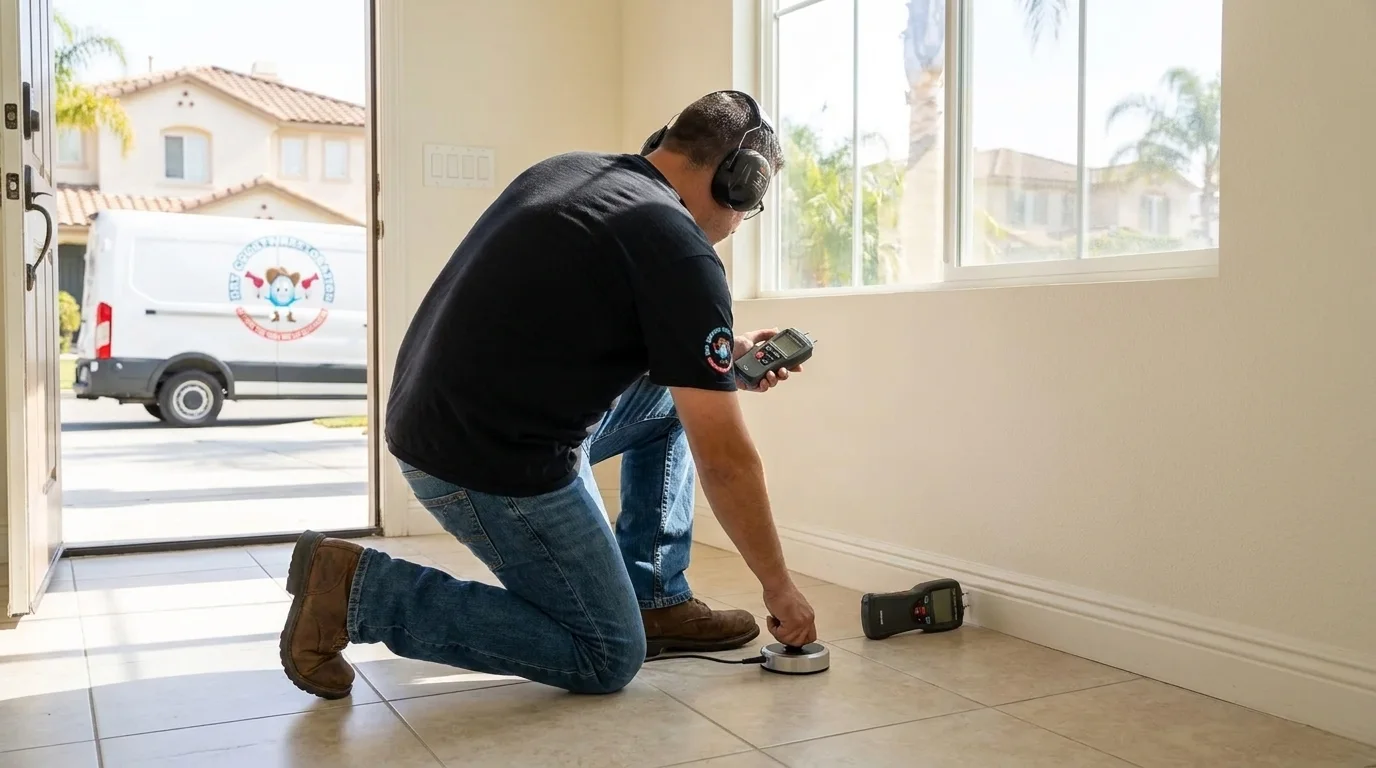
We start by ruling out the obvious: toilets, irrigation valves, water heaters, and any visible plumbing before assuming the leak is behind a wall or under a slab. From there we use acoustic listening equipment to trace the sound of pressurized water moving through pipe, and thermal imaging to spot temperature differentials in flooring and drywall that indicate moisture migration. On slab leaks specifically, we isolate the line section by section with pressure testing rather than guessing at a location, because cutting concrete in the wrong spot in a Long Beach home with a finished slab or radiant flooring is an expensive mistake to undo. Once we’ve confirmed the leak’s location, we document it with photos and moisture readings before any repair or demolition begins, which matters if you’re filing a claim.
Long Beach Insurance & HOA Coordination
Slab leaks and hidden wall leaks fall into a gray area with a lot of homeowner policies: the leak itself may be covered as sudden and accidental, but gradual damage from a slow leak that’s been running for weeks is often excluded. That’s why documentation at the detection stage matters, it’s the evidence that supports whether a claim gets approved. For condos and townhomes in Long Beach’s many multi-unit buildings, we also coordinate with property managers or HOA boards when a leak originates in a shared wall or below a unit, since responsibility for the repair can shift depending on whether the line serves one unit or the building’s common plumbing.
Equipment & Methods We Use
Beyond acoustic and thermal tools, we use moisture meters to confirm how far water has traveled through flooring, baseboards, and drywall before we recommend opening anything up. On older Long Beach properties with cast iron or galvanized supply lines, we also check for pinhole corrosion patterns that tend to cluster near fittings and elbows rather than along a straight run of pipe, which changes where we focus the inspection.
Local note
A lot of Long Beach’s single-story post-war homes have their main water line running under the slab at a shallow depth compared to newer construction standards, which means a slab leak here can surface as a wet spot on the carpet or vinyl flooring faster than it would in a home with deeper-set plumbing. It’s a small detail, but it’s often why a homeowner notices the problem within days rather than weeks, and why getting someone out to trace it quickly can keep the repair to a single cut in the slab instead of a larger section.
If you’re seeing an unexplained spike on your water bill, a warm patch on the floor, or the sound of water running when nothing’s turned on, don’t wait for it to get worse. Dry County Restoration is licensed (#1083555), IICRC certified, and available 24/7 to send a technician out to your Long Beach property with the equipment to find the leak and document it properly from the start.
Serving Long Beach from our Corona headquarters — ★ 5.0 · 100 Google reviews
“Communicative and professional.” — Larry, October 2026Read our reviews on Google →
Water Leak Detection in Long Beach: Service Coverage
Frequently Asked Questions
How fast can you arrive for water leak detection in Long Beach?
How do you find a slab leak in a Long Beach home without tearing up the whole floor?
Will my homeowner's insurance cover a hidden water leak in Long Beach?
Are older Long Beach homes more prone to hidden leaks?
What happens if the leak is in a shared wall in a Long Beach condo or townhome?
How long does leak detection take before you know where the water is coming from?
Water Leak Detection response in Long Beach
Most Long Beach calls see a technician on-site within about 2 hours from our Corona headquarters.