Mold Remediation in Long Beach
Mold remediation in Long Beach, CA. IICRC-certified, insurance billing accepted. Call (951) 667-9910.
Our IICRC-certified technicians are dispatched from our Corona, CA headquarters and are typically on-site in Long Beach within about 2 hours of your call.
Mold remediation in Long Beach? The marine layer that rolls off the harbor most mornings keeps indoor humidity elevated for months at a time, and that moisture finds its way into stucco walls, crawlspaces, and slab foundations faster than most homeowners expect. By the time a musty smell reaches the living room, colonization behind drywall or under flooring is usually already well underway.
Why Long Beach Properties See Mold Issues
Long Beach sits close enough to the water that indoor humidity rarely drops as low as it does further inland, even during the dry season. Homes built on slab foundations, which make up a large share of the city’s postwar housing stock, don’t have a crawlspace to vent moisture the way raised foundations do, so a slow plumbing leak or irrigation runoff against the foundation wall can sit trapped against the slab for weeks before it surfaces as a visible stain or odor. Older stucco construction common throughout the city also traps moisture differently than modern siding systems: stucco is permeable enough to absorb coastal humidity directly, which means mold can establish on the interior face of exterior walls even without an obvious water event. Add in salt-air corrosion on HVAC coils and condensate lines, a known issue for coastal Southern California properties, and you get a steady source of condensation moisture feeding growth inside wall cavities and air handlers that a homeowner never sees directly.
Our Mold Remediation Process in Long Beach
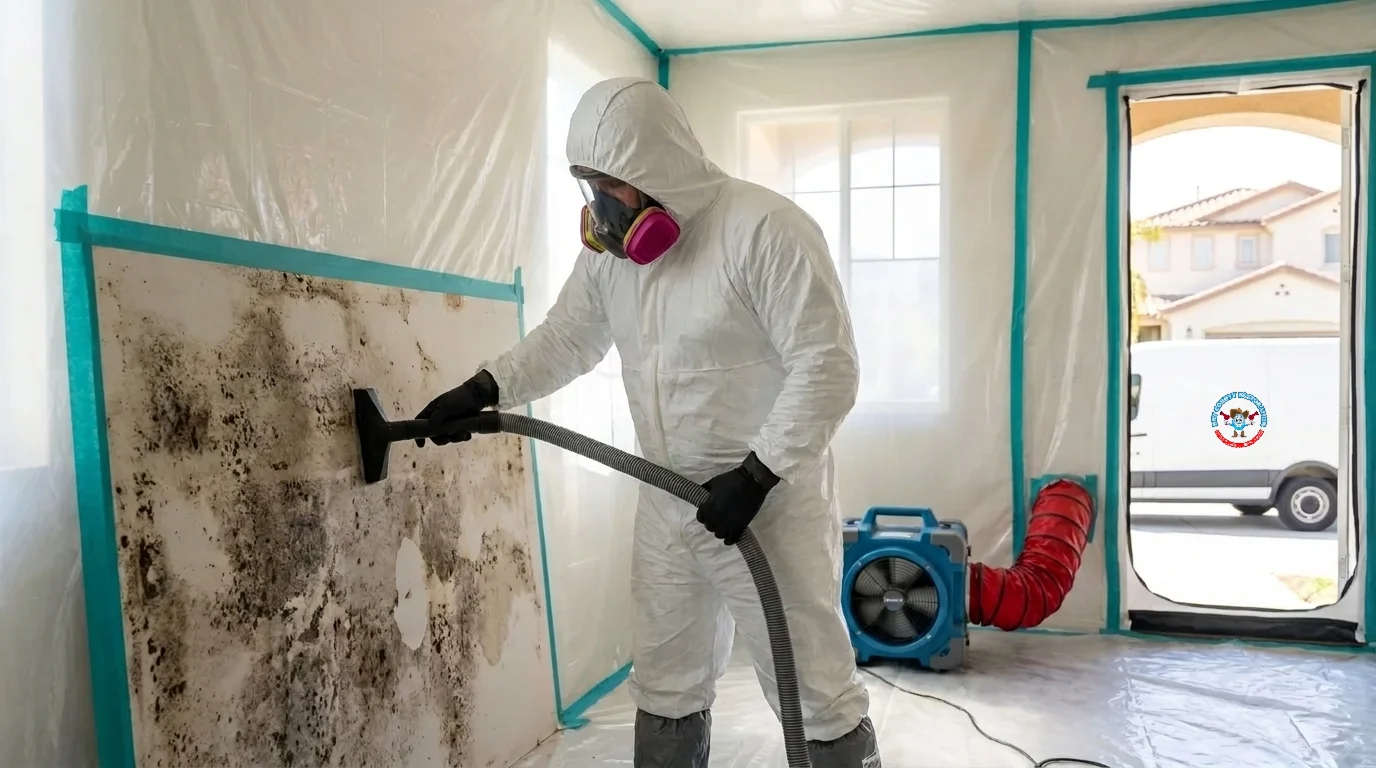
We start every job with a moisture map, not a visual inspection alone, because surface mold is often just the visible edge of a larger colonized area hidden inside wall cavities or under flooring. Containment goes up before any disturbance begins: negative air pressure chambers with HEPA filtration keep spores from migrating into unaffected rooms, which matters more in Long Beach’s older multi-family buildings where units often share wall cavities and HVAC returns. Affected porous materials, drywall, insulation, some flooring, get removed and bagged for disposal rather than treated in place, since porous materials rarely clean back to a safe condition once colonized. Non-porous surfaces get HEPA-vacuumed and treated with antimicrobial solution. Our crews work under IICRC AMRT protocols for the remediation itself, and we document every stage with photos for your insurance file. Once remediation is complete, we run air scrubbers and dehumidifiers to bring the space back to a normal moisture baseline before any reconstruction begins, which is particularly important in slab-foundation homes where the concrete itself can hold residual moisture longer than framing lumber does.
Long Beach Insurance & HOA Coordination
Mold claims in Long Beach often hinge on whether the moisture source was sudden and accidental, like a burst supply line, versus gradual, like a slow roof leak or long-term condensation issue, since most policies treat those two scenarios very differently. We photograph and document the originating moisture source alongside the mold itself, which gives your adjuster the context needed to process the claim without back-and-forth delays. Condo and townhome associations in the city’s coastal and waterfront-adjacent buildings frequently require a third-party clearance test before a unit can be reoccupied or before an HOA will sign off on common-area repairs; we coordinate scheduling around that requirement so the clearance test happens as soon as our remediation work is ready for it, rather than adding an extra week of waiting.
Local note
One pattern we watch for specifically in Long Beach: window-mounted and through-wall AC units, common in older apartment buildings and converted duplexes near the city core, often have condensate lines that drain poorly against stucco exteriors. Over a few seasons that constant drip saturates the stucco and sheathing behind the unit, and the mold shows up two or three feet away from where the actual moisture source sits, which is why we always check AC penetrations even when the visible growth is nowhere near them.
If you’re dealing with a musty smell, visible staining, or a known leak that’s gone unaddressed, Dry County Restoration handles mold remediation for homes and multi-family buildings throughout Long Beach, from older stucco bungalows to coastal condos. Call (951) 667-9910 to get a moisture assessment scheduled and start the documentation your insurance or HOA may require.
Serving Long Beach from our Corona headquarters — ★ 5.0 · 100 Google reviews
“Communicative and professional.” — Larry, October 2026Read our reviews on Google →
Mold Remediation in Long Beach: Service Coverage
Frequently Asked Questions
How fast can you arrive for mold remediation in Long Beach?
Does Long Beach's coastal humidity make mold remediation take longer than inland cities?
Are Long Beach homes with slab foundations more prone to hidden mold?
Will my Long Beach HOA require air clearance testing after mold remediation?
What does the mold remediation process actually involve?
Will my insurance cover mold remediation for a Long Beach property?
Mold Remediation response in Long Beach
Most Long Beach calls see a technician on-site within about 2 hours from our Corona headquarters.