If the air movers are gone, the moisture readings came back dry, and you’re left staring at open studs and a missing section of ceiling, call Dry County Restoration at (951) 667-9910 to handle the rebuild. Dry County is an IICRC Certified Firm licensed in California (CSLB #1083555) and takes calls 24/7, so you’re not stuck waiting until Monday to find a crew that will put your Corona home back together once the drying contractor signs off.
Mitigation vs. Reconstruction: Who Do You Actually Call?
Mitigation and reconstruction are two different jobs, and mixing them up is the most common reason a rebuild stalls. Mitigation is the drying phase: extracting standing water, running air movers and dehumidifiers, and documenting that the structure has returned to a dry standard. Reconstruction is everything that happens after: new drywall, texture, paint, flooring, cabinetry, and trim.
If you already worked through the drying phase, you’ve likely seen our Who to Call for Water Damage Restoration in Corona, CA post, which covers that first call. This post picks up where that one leaves off. Some mitigation-only companies hand you a dry certificate and walk away, leaving you to find a separate general contractor. Dry County holds both the water damage restoration and reconstruction scope under one license, so there’s no gap between drying and rebuilding, and no second company re-learning your claim from scratch.
Why Your Rebuild Can’t Start Until the Drying Numbers Are Signed Off
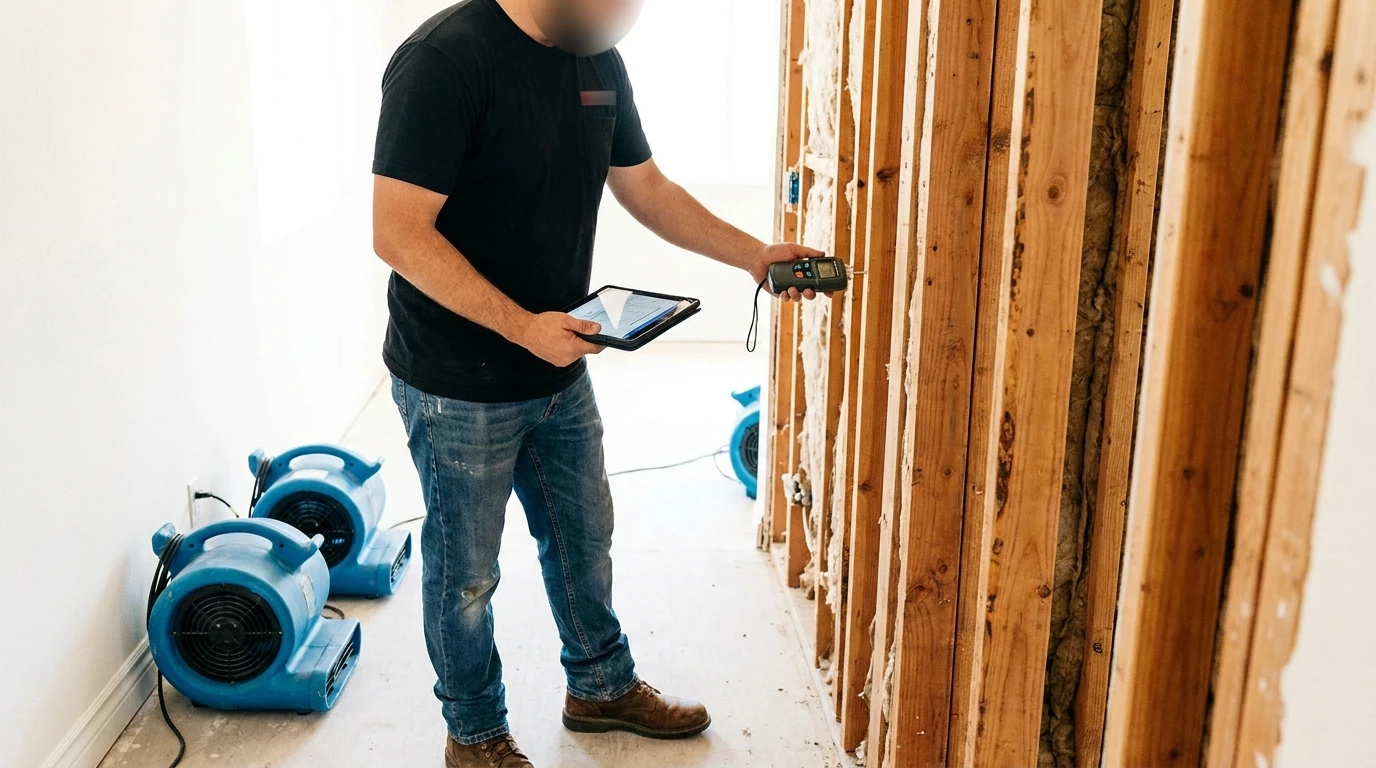
A reconstruction crew should never close up a wall until the mitigation technician has documented dry readings with a moisture meter, because trapped moisture behind new drywall is how a one-week repair turns into a mold job. The ANSI/IICRC S500 standard is the industry benchmark drying technicians use to confirm materials have returned to a normal moisture range before reconstruction begins.
Ask for that documentation in writing before anyone picks up a drill. It protects you three ways: it gives your rebuild contractor a defensible starting point, it gives your insurer proof the structure was actually dry, and it protects you if a wall gets reopened down the road and someone asks what the readings were on closing day.
What Does the Rebuild Actually Cover?
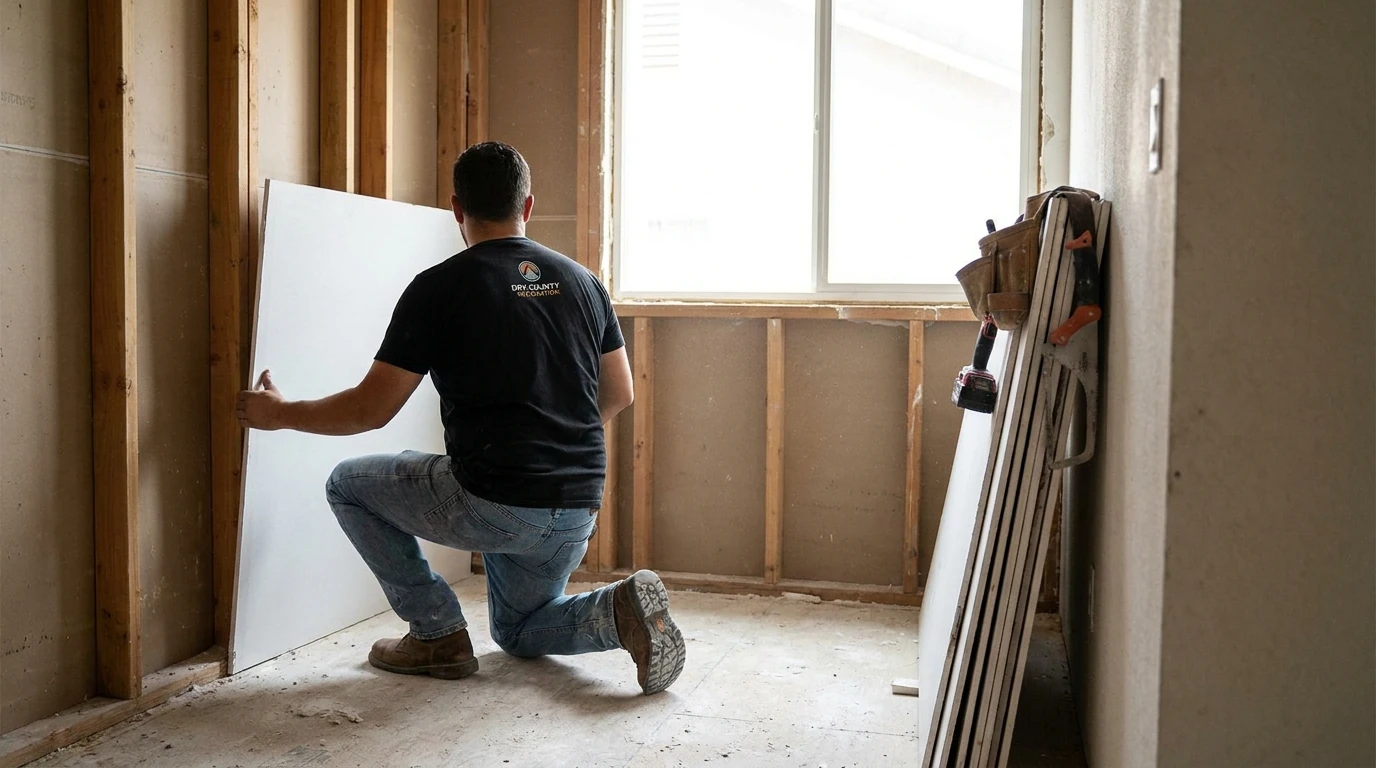
Rebuilding after water damage in a Corona home typically means replacing drywall, repairing or replacing ceiling sections, matching texture and paint, and addressing flooring and cabinetry that absorbed water. Ceilings are their own category of headache: a slow leak from a second-floor bathroom or an attic HVAC line often shows up as a stained or sagging ceiling long after the original leak, which is why we treat ceiling water damage repair as its own line item rather than a drywall afterthought.
Cabinets and baseboards near the original water source usually need removal during drying and reinstallation (or replacement) during reconstruction. Flooring depends on the material: vinyl plank and tile often survive if dried quickly, while particleboard subfloor and swollen laminate usually don’t. Paint and texture matching is the last step, and it’s where a lot of rebuilds go sideways if the contractor doesn’t blend the repair into the surrounding wall or ceiling.
What About the Adjuster’s Estimate and Supplements?
The adjuster’s first estimate is a starting point, not a final number, and it’s common for the actual rebuild cost to exceed it once walls are open and hidden damage is visible. That gap gets closed through a supplement: additional documentation your contractor submits to the insurer showing the extra scope and cost once it’s discovered.
This is where a contractor who understands insurance paperwork earns their keep. The Insurance Information Institute’s guide to settling claims after a disaster walks through how the claims process generally works, including the back-and-forth between contractor estimates and adjuster approval. Dry County writes a documented scope before work begins and handles supplement requests directly with the adjuster so you’re not the one chasing paperwork between two offices.
How Do I Check a Contractor’s License Before I Sign?
Any contractor rebuilding your home after water damage in California should hold an active CSLB license, and you can verify it yourself in under a minute at the CSLB’s online license lookup. Enter the license number from the estimate or contract and confirm the status is active, the classification matches the work (general building, not just a specialty trade), and there’s no current disciplinary action.
The CSLB’s own guide to hiring a contractor recommends getting a written contract with a defined scope before any demolition or rebuild work starts, which matters even more when insurance money is involved. Dry County’s license number, 1083555, is listed on every estimate we write for Corona homeowners, and it’s easy to confirm independently before you sign anything.
What Happens When You Call
When you call, have your insurance claim number and the mitigation company’s dry certificate or final drying report ready if you have one. A project manager walks the affected areas with you, documents what needs to be replaced versus repaired, and puts together a written scope before any demo or framing starts.
From there, rebuild work moves in order: framing and drywall first, then texture and paint, then flooring and cabinetry, with final punch-list items like trim and touch-up paint closing out the job. You get a single point of contact through the whole rebuild instead of juggling a drying company, a separate contractor, and the adjuster on three different calls.
If you’re standing in a Corona home right now with open walls and no clear next step, whether it’s a 1970s place near Circle City or a newer build out by Dos Lagos, the fastest path to getting it closed back up is a written scope from a licensed crew that already knows your drying history.
About Dry County Restoration
Dry County Restoration is an IICRC Certified Firm based in Corona, CA, operating since 2020 under California contractor’s license #1083555. The company’s technicians hold IICRC credentials in water restoration, structural drying, and mold remediation, and the firm answers calls 24/7. Dry County handles water damage mitigation and the reconstruction that follows it, drywall, ceilings, flooring, and cabinetry, for homeowners across Corona, Riverside, Anaheim, and the surrounding Inland Empire.