TL;DR: If water is spreading through your Norco home right now, shut off the source if you can safely reach it, then call Dry County Restoration at (951) 667-9910. The company is IICRC-certified in water restoration and structural drying, licensed in California (#1083555), and takes calls 24/7. Getting extraction and drying equipment on site within hours, not days, is what keeps a wet room from turning into a mold problem two weeks later.
Norco deals with water damage differently than most of Riverside County. Wide horse properties, private wells, septic systems, and ranch-style homes built before current slab-leak detection standards mean leaks often run longer before anyone notices. If a pipe let go under your kitchen slab, a supply line to a wash rack split overnight, or a water heater failed in the garage, call (951) 667-9910. That line answers around the clock, and the sooner a crew starts pulling water, the less drywall, flooring, and framing you lose.
When do I call a restoration company instead of a plumber?
Call a restoration company once the water has stopped flowing or you’ve shut off the source; call a plumber first only if water is still actively running and you can’t find a shutoff valve. The two jobs are different and most homeowners only need one of them urgently.
A plumber fixes the pipe, valve, or appliance that failed. A restoration company extracts standing water, pulls moisture out of drywall and subfloor with air movers and LGR dehumidifiers, and documents everything for your insurance adjuster. On a lot of Norco properties, especially those on River Road or around Temescal Avenue with private wells, the plumbing work and the drying work genuinely need separate trades. If you’re not sure which one you need, call the restoration company first. A real crew will tell you honestly if the leak needs a plumber before they can start drying, instead of running equipment on a problem that’s still getting worse.
What about a flooded barn, downed power lines, or a gas smell?
Utility hazards take priority over calling anyone else. If you smell gas, see a downed line, or water is near an electrical panel, get everyone clear and call 911 or the utility company before you call a restoration crew.
Norco’s equestrian lots often put a well pump, electrical panel, or propane tank near the same low spot where water collects, so a flooded barn or tack room is not just a cleanup problem. Shut off breakers at the main panel only if you can do it without stepping in standing water. If flooding is coming from the Santa Ana River basin or a storm drain overflow near Temescal Wash rather than a plumbing failure, that’s a call to Riverside County Flood Control, not a restoration company, until the water recedes enough to assess structural damage safely.
What happens when the crew gets there?
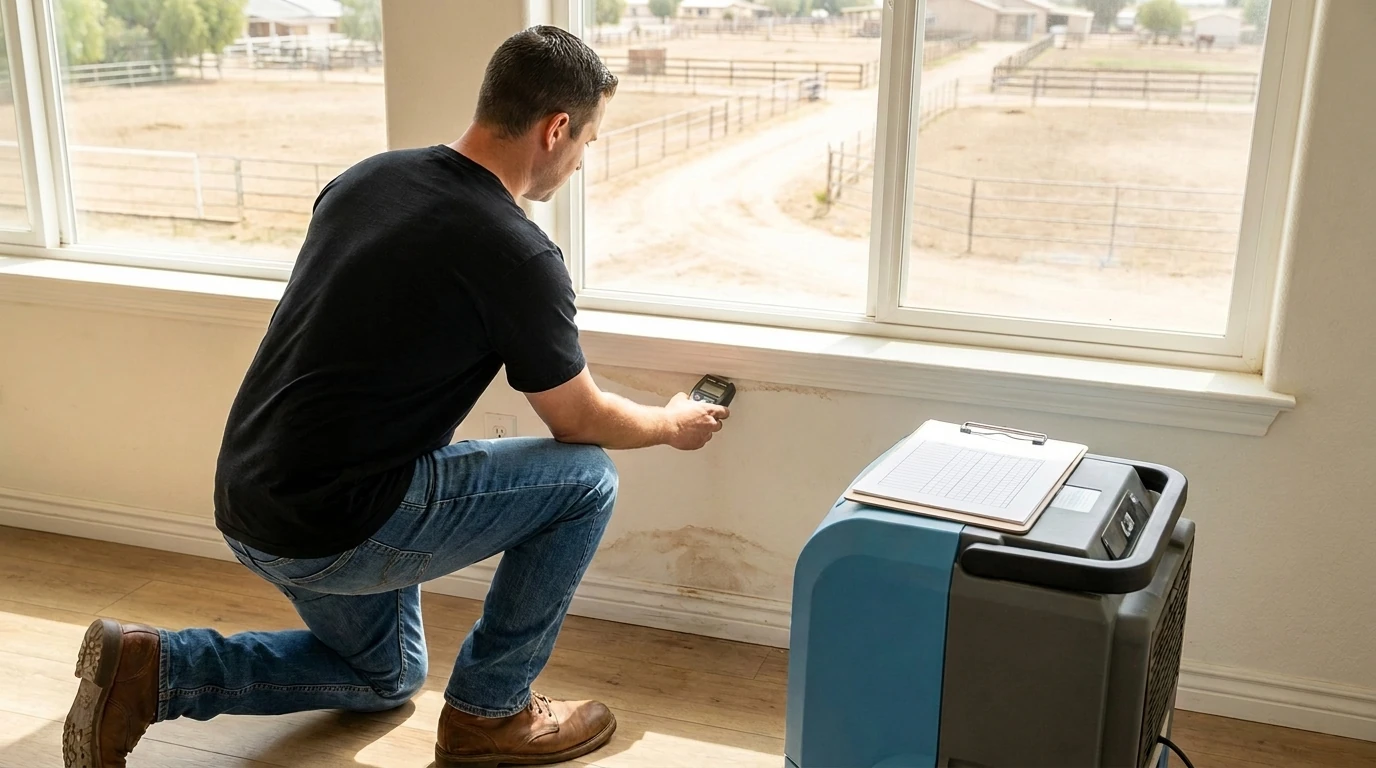
A restoration crew arrives, confirms the water source is controlled, then starts moisture mapping before they move a single piece of equipment. That mapping, done with a moisture meter and often a thermal camera, is what tells them how far the water traveled under flooring and inside walls, which matters for both the drying plan and the insurance claim.
Have your address, a rough idea of what caused the water, and whether your power and water are currently on or off ready when you call. The crew will extract standing water, set containment if needed, and place air movers and dehumidifiers to dry the structure, typically checking moisture levels daily until materials read dry to the IICRC S500 standard. They’ll also photograph and log the damage, which is the documentation most homeowners policies require before approving a water damage claim. If you haven’t already, see our burst pipe emergency checklist for what to do in the first few minutes before help arrives.
Should I call my insurance company before or after the restoration crew?
Call the restoration crew first, then your insurance company once mitigation is underway. Most policies require you to stop ongoing damage as soon as reasonably possible, and a restoration company’s documentation (photos, moisture logs, a written scope) is exactly what an adjuster needs to process the claim. Calling insurance first and waiting for an adjuster visit before starting extraction usually just means more drywall and flooring are lost by the time anyone shows up.
If a pipe failed, a water heater gave out, or a horse-property irrigation line split overnight and you’re standing in it right now, don’t wait to see if it dries on its own. Call Dry County Restoration at (951) 667-9910 for a moisture assessment and a written scope of work before anything is repaired.