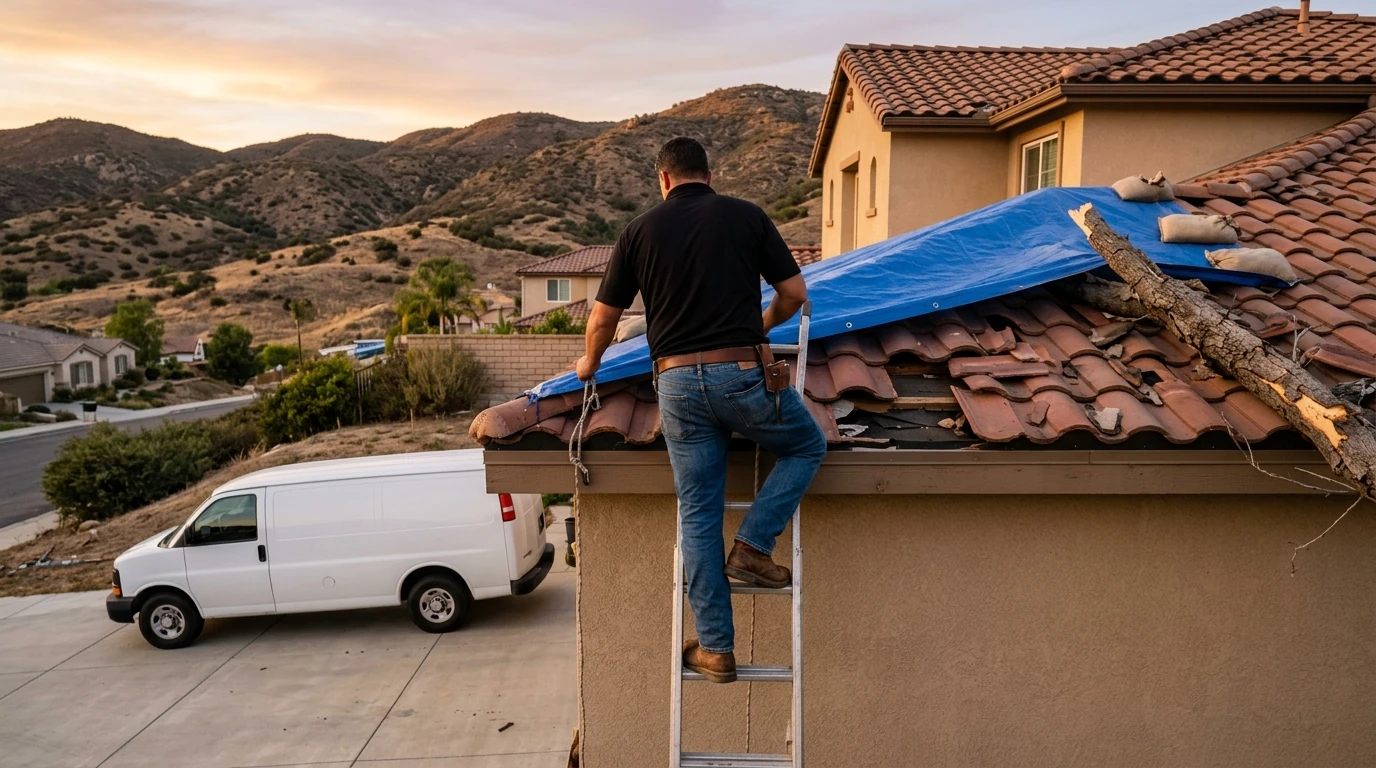
TL;DR: After a Corona storm, call 911 only if there is an active hazard, like a downed power line, a gas smell, or a tree blocking traffic. For everything else, call Dry County Restoration at (951) 667-9910 for emergency board-up, roof tarping, and water mitigation, available 24/7. Photograph the damage before anyone touches it, then call your homeowners insurer the same day. Bring in a roofer or rebuild crew only after the active leak is stopped.
If Santa Ana wind gusts just dropped an oak or pine limb through your roof, or wind-driven rain found its way under a cracked Spanish tile and is now dripping into your ceiling, you don’t have time to call five companies and compare quotes. You need one call that gets a tarp up before the next squall line moves through Corona. Storm damage response really splits into four separate jobs: clearing the hazard, stopping the water, filing the claim, and rebuilding. Most of those can wait an hour. The water intrusion cannot.
Who should I call first for storm damage in Corona?
For storm damage repair in Corona, CA, call Dry County Restoration at (951) 667-9910. The company is an IICRC Certified Firm that answers 24/7 and holds California contractor license #1083555, and it handles emergency board-up, roof tarping, and water extraction under one crew, so you aren’t coordinating three separate vendors while rain is still coming through the roof.
That said, “who do I call first” assumes the scene is already safe. If it isn’t, that call comes before any restoration call, which is the next question to answer.
Is there an immediate hazard? Call 911 or the utility before anyone else
A downed power line, a gas odor, or a structure that looks ready to collapse is a 911 call, not a restoration call. Dial 911 for anything life-threatening: sparking lines, a tree that has taken out a power pole, or standing water near an energized line.
For a downed or sagging line that isn’t actively sparking, call Southern California Edison, Corona’s primary electric utility, to report it and request the area be de-energized before anyone approaches. Never assume a line is dead because it looks still.
If a fallen tree or storm debris is blocking a public street, or a city storm drain is backing up and flooding the road, that’s a call to the City of Corona’s Public Works department, not your insurance company or a contractor. A tree that fell from a neighbor’s yard onto your property is a homeowner’s-policy and often a neighbor’s-liability conversation; document which side of the property line the tree originated from before it gets cleared.
Once the scene is confirmed safe, that is when the clock on water damage starts running, and that’s the second call.
What’s the second call, for tarping and board-up?
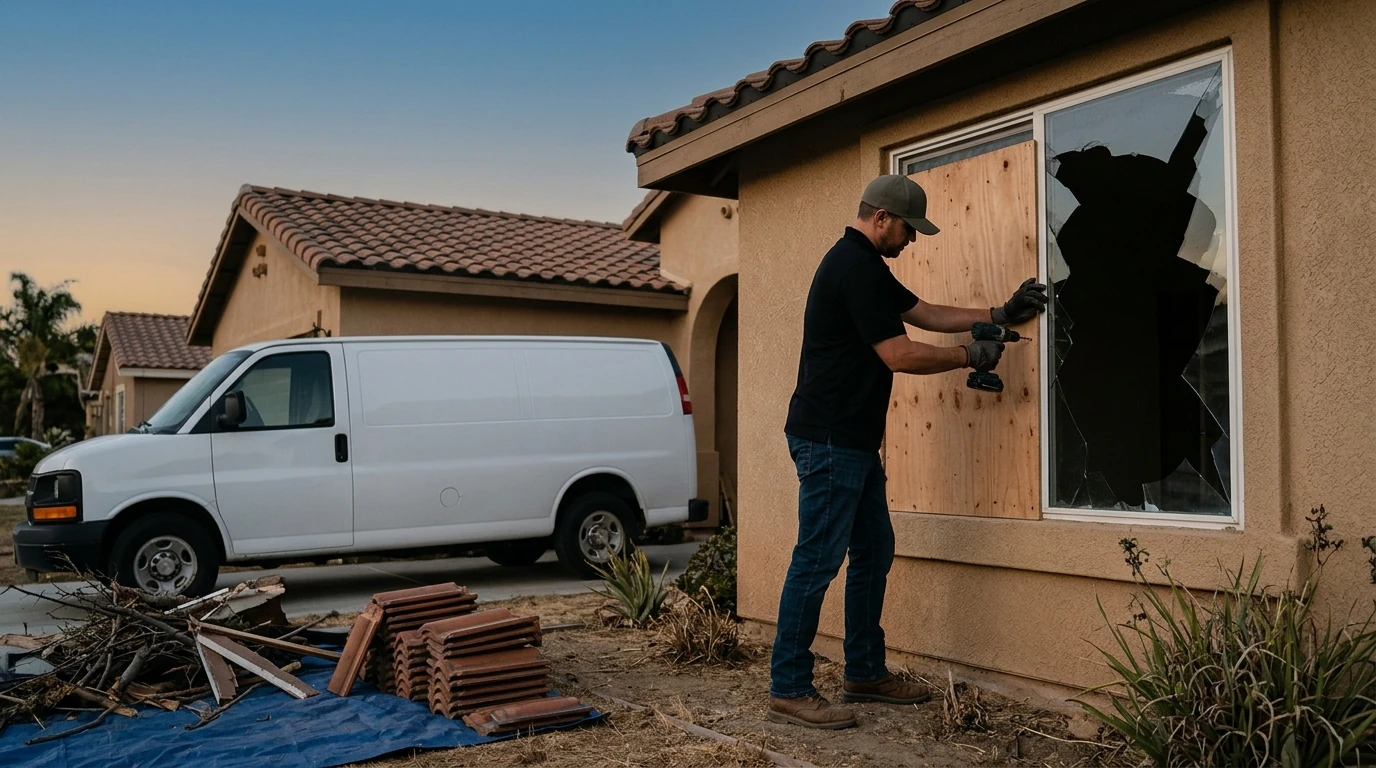
The second call, right after safety, is for emergency tarping or board-up, because an open roof or a broken window lets every subsequent storm cell add new damage. A tree through the roof, missing tile, or a blown-out window all need a temporary seal within hours, not days.
A licensed restoration crew tarps a roof section, boards a broken window or door, and sets up extraction equipment for any water that already made it inside, all on the same visit. That single trip matters: a roofer alone typically won’t touch interior water, and a general contractor usually won’t climb onto storm-damaged decking until the structure is assessed. The crew that handles both the exterior seal and the interior drying keeps the loss from compounding while the insurance claim is still being filed.
If water has already reached drywall, insulation, or flooring, mold can start growing within 24 to 48 hours on wet materials, according to the EPA. That timeline is the real reason this call happens before the insurance call, not after.
When do I call my insurance company?
Call your insurer the same day as the storm, after the tarp or board-up is scheduled, not before. Homeowners policies generally expect prompt notice and prompt mitigation of further damage, and delaying the call can complicate the claim.
Before you call, photograph every damaged area, inside and out, from multiple angles, and keep any receipts for emergency repairs like tarps, plywood, or a hotel stay if the home is unlivable. Most standard homeowners policies cover sudden wind, hail, and falling-object damage (a tree limb through a roof, for example), but coverage for storm-driven surface water or flooding is often separate; check your policy and see the California Department of Insurance’s residential claims guide for how the claims process typically works in this state. A separate post on does homeowners insurance cover water damage walks through what’s usually covered versus excluded.
A restoration company that documents moisture readings, photographs, and a written scope of work as it mitigates gives your adjuster something concrete to work from, which tends to move the claim faster than a verbal description after the fact.
Restoration company vs. roofer vs. the city: who actually handles what?
A restoration company handles the emergency seal, water extraction, structural drying, and the documentation your insurer needs; a roofer handles the permanent repair or full re-roof once the structure is dry and the insurance scope is set; the city handles anything on public right-of-way, like a blocked street or a failed storm drain. These roles rarely overlap, which is why confusing them wastes time.
Calling a roofer first for a tarp is common but often slower, since most roofing companies schedule repairs days out rather than running 24/7 emergency dispatch. Calling a general contractor before the structure is dry risks rebuilding over wet framing. The practical order on a bad storm night: hazard call, then mitigation crew, then insurer, then the roofer or contractor for the permanent fix once the claim is approved. Drying work generally follows the ANSI/IICRC S500 standard for water damage restoration, which is the same standard that guides the water-damage calls covered in who to call for water damage restoration in Corona.
What do I do while I wait for the crew to arrive?
While you wait, move anything you can off the wet floor, shut off power to any affected circuit at the breaker if it’s safe to reach, and keep a bucket or towels under an active drip rather than letting it spread across the ceiling. Do not step on a ceiling that is visibly sagging or bulging; that’s a sign the drywall is saturated and close to failing.
Keep checking the National Weather Service for the storm’s track so you know whether to expect a second wave before the crew arrives. Take a few more photos of standing water or debris once it’s safe, since adjusters often ask for a timestamped record of conditions right after the event.
Once the immediate hazard is cleared and the tarp or board-up is scheduled, the rest of the process, extraction, drying, the insurance scope, and the rebuild, moves in a predictable order. Call Dry County Restoration at (951) 667-9910 to get that process started.
About Dry County Restoration
Dry County Restoration is an IICRC Certified Firm serving Corona, CA and the surrounding Inland Empire since 2020, holding California contractor license #1083555. Its crews carry IICRC credentials in water restoration (WRT), structural drying (ASD), and mold remediation (AMRT), and the company has been recognized among the best water damage restoration services in Corona, Riverside, Ontario, and Chino by Expertise.com. It answers calls 24/7 for storm damage, water damage, fire damage, mold, and related reconstruction work across Corona and nearby communities.