Some restoration jobs wrap up in an afternoon: a leak gets dried, a report gets written, the crew packs up. Others take days of return visits, moisture checks, and equipment adjustments before the work is finished. The review below describes the second kind, and it’s worth unpacking because the day-to-day experience of a multi-day job is rarely what homeowners expect going in.
I am extremely pleased with the work Dry County did for me. They were very friendly, thoughtful and thorough. I exactly looked forward to them coming everyday. ❤️ I highly recommend them.
, verified Google review
Why some restoration jobs take several days, not one visit
A review that mentions a crew “coming everyday” is almost always describing a job that required active monitoring over multiple days, not a one-and-done repair. Several of the services Dry County Restoration handles work this way, including water damage restoration, structural drying, and mold remediation.
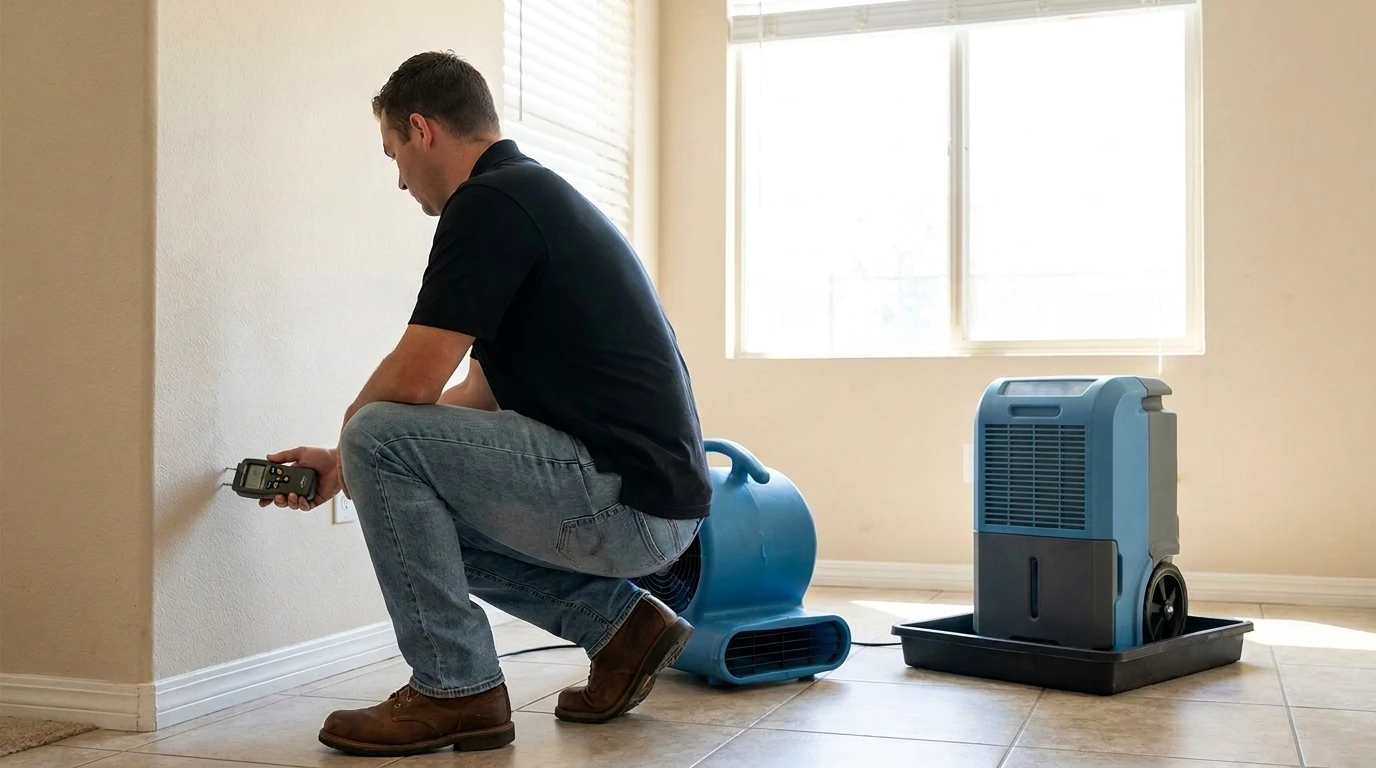
With a water-damage job, for example, equipment doesn’t just get dropped off once. Air movers and dehumidifiers get placed on day one, then a technician typically returns daily to log moisture readings, reposition equipment as materials dry at different rates, and confirm the structure is actually drying on schedule rather than just assumed to be drying. The ANSI/IICRC S500 standard that governs professional water damage restoration specifically calls for this kind of monitoring until drying goals are documented as met, not just estimated.
That daily return isn’t an inconvenience built into the process. It’s the part of the process that determines whether the job is actually done right, or just looks done.
What “thorough” looks like in daily visits
“Thorough” in a daily-monitoring job means a technician is measuring and documenting, not just glancing at equipment. Each visit typically includes moisture meter readings on affected materials, a check of relative humidity and temperature in the work area, and a comparison against the drying goals set on day one.
That documentation matters for two reasons. First, it’s how a technician knows when a space is actually dry versus when it just feels dry to the touch; wood framing and subfloor can hold moisture well after the surface appears normal. Second, it becomes the paper trail an insurance adjuster will want to see if the loss is part of a claim. A job file with daily readings is a stronger claim file than one with a single before-and-after photo.
The same logic applies to mold remediation, where containment integrity and air quality get checked at intervals rather than assumed to hold for the duration of the job, consistent with the ANSI/IICRC S520 mold remediation standard.
What “friendly and thoughtful” actually means on a multi-day job
“Friendly and thoughtful” is doing a lot of work in that review, and it points to something specific: a crew that treats a homeowner’s house like someone still lives there during the repair. On a job that stretches across several days, that means consistent communication about what today’s visit will involve, what changed since yesterday, and a realistic estimate of how many more days remain.
It also means respecting that a stranger showing up at your home daily is inherently uncomfortable, even when the work is welcome. Crews who explain each step, keep noise and disruption predictable, and show up when they say they will turn a stressful situation into one a homeowner can actually tolerate, which is a big part of why a review like this one exists at all.
When a job like this makes sense for your home
If you’re dealing with standing water, a slow leak that’s been going for more than a day or two, or visible mold growth, a multi-day monitored job is often what the situation actually requires, even if the damage looks minor on day one. A single visit can stop active water, but it can’t confirm a structure has fully dried, and skipping that step is how hidden moisture turns into a mold problem weeks later.
Homeowners dealing with an active water loss can read more in what to do in the first 24 hours after water damage, which covers the decisions that happen before a drying job like this one even starts.
If your home needs the kind of daily-monitored drying or remediation described above, request a moisture assessment and ask what the expected timeline looks like before work begins.
About Dry County Restoration
Dry County Restoration is an IICRC Certified Firm serving Corona, CA and the surrounding Inland Empire since 2020, licensed under CSLB #1083555 and available 24/7. Their technicians hold IICRC credentials in water damage restoration, structural drying, and mold remediation, and the company handles water damage, mold, fire and smoke, storm, and reconstruction work across the region. This case study was prepared with the Dry County Restoration team by Bob Olson.
Need help now? Call Dry County Restoration at (951) 667-9910.